


Travel Business First · Cabin Comparison · 2026
PE
Premium Eco
J
Business
Business Class vs
Premium Economy
Which Is Worth It in 2026/2027?
Seat, sleep, service, lounges and price compared side by side — the honest UK guide to choosing the right cabin for your long-haul flight.
Quick Answer
"Premium economy gives you a wider seat, more legroom and better food than economy, but the seat still reclines rather than lying flat. Business class adds a fully flat bed, direct aisle access, lounge access, fast-track and chauffeur services — at roughly two to three times the price. Business class is worth the upgrade on overnight and ultra-long-haul flights where sleep matters; premium economy is strong value on shorter daytime routes."
— Travel Business First, UK Business Class Specialists · 2026
It's the question almost every long-haul traveller weighs up: is it worth paying more for business class, or does premium economy give you enough comfort for far less? Both cabins sit between economy and first, but they offer very different experiences — and the right answer depends on your route, your priorities and how much a good night's sleep at 38,000 feet is worth to you.
This honest guide from Travel Business First compares business class and premium economy across every dimension that matters — the seat, sleep, food, service, lounges, ground experience and price — so you can decide which cabin is genuinely worth it for your next trip.
The Core Difference: A Bed vs a Better Seat
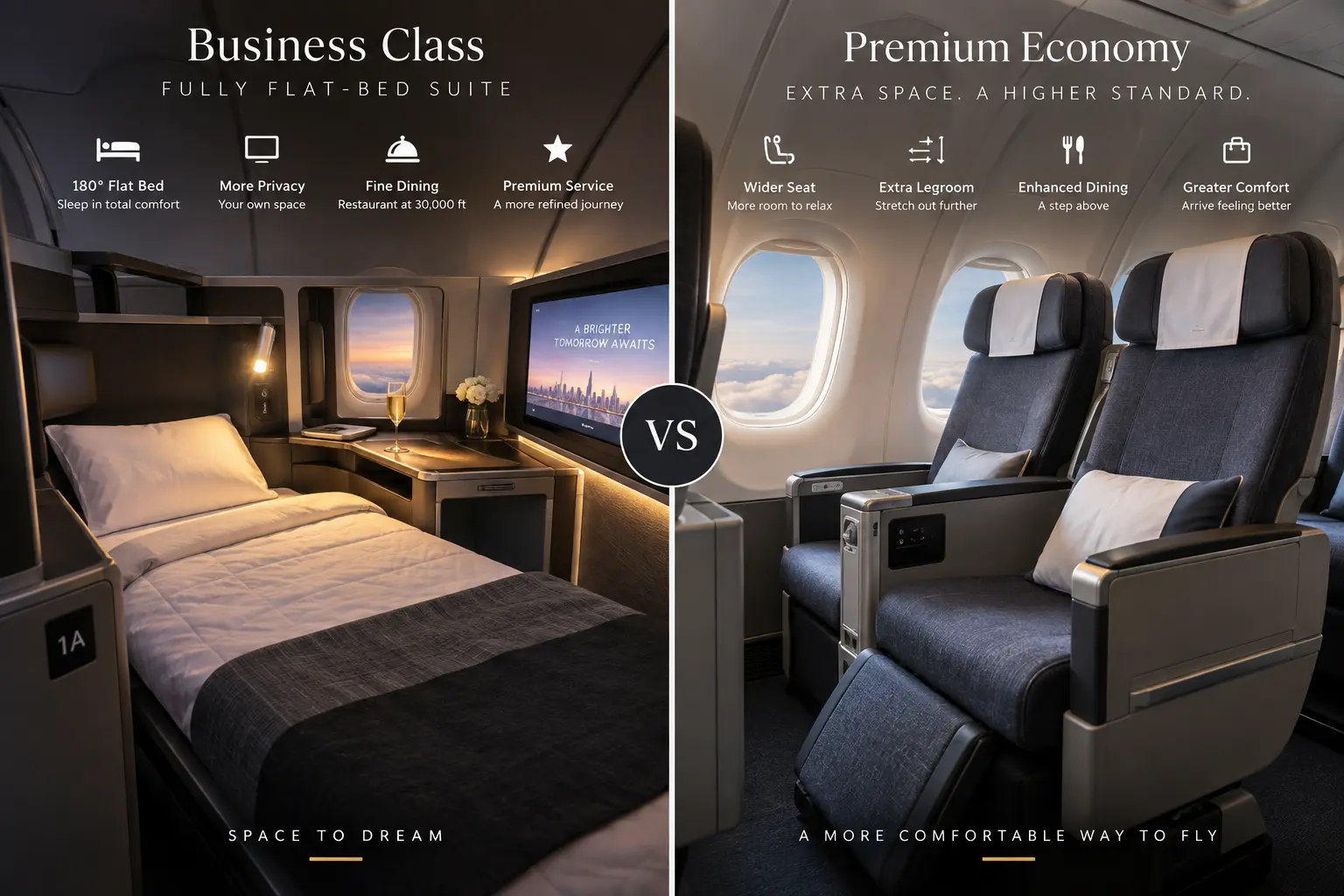
The single most important distinction is simple: business class gives you a bed, premium economy gives you a better seat. On a long-haul aircraft, business class converts into a fully flat bed, almost always with direct aisle access and increasingly with a privacy door. Premium economy is an enhanced recliner — wider than economy, with more legroom and recline, a footrest and a larger tray — but it does not lie flat.
That one difference cascades into everything else. If you can lie flat, an overnight flight becomes a night's sleep and you arrive ready to go. If you can't, you arrive having dozed in a reclined seat — more comfortable than economy, but still tired. Whether that gap is worth two to three times the fare is the whole question, and the answer depends almost entirely on the type of flight.
Side by Side: Business Class vs Premium Economy
| Feature | Premium Economy | Business Class |
|---|---|---|
| Seat | Wider recliner, ~38" pitch | Fully flat bed |
| Aisle access | No (seatmates) | Direct (most aircraft) |
| Sleep | Reclined only | Flat, with bedding |
| Lounge access | No* | Yes |
| Fast-track security | Sometimes | Yes |
| Chauffeur | No | On some airlines (Virgin) |
| Dining | Enhanced tray service | Multi-course, on demand |
| Baggage | 2 bags (enhanced) | 2 bags up to 32kg + priority |
| Typical price | 1× (base) | 2–3× premium economy |
*Premium economy generally does not include lounge access unless you hold elite frequent-flyer status. This end-to-end premium experience — lounge, fast-track, priority, chauffeur — is a defining part of what you pay for in business class, beyond the seat itself.
The Seat: What You Actually Get
In premium economy, expect a seat roughly two to three inches wider than economy, with around 38 inches of pitch (legroom), a deeper recline of perhaps eight inches, a leg rest and a foot bar. You'll get a larger tray table, a bigger personal screen, a proper pillow and blanket, and an amenity kit. It's a meaningful step up — the cabin is smaller and quieter, and you're no longer wedged in — but you remain in a seat you recline in, usually with a seatmate to climb over.
Business class is a different category of product entirely. On modern long-haul aircraft you get a seat that reclines to a fully flat bed six feet or more in length, direct aisle access so you never disturb or get disturbed by a neighbour, and increasingly a privacy door that turns the space into a personal suite. Add a proper duvet and pillow, a large HD screen, generous storage and a wide console, and you have somewhere to work, dine, watch and genuinely sleep. Products like Qatar's QSuite and ANA's The Room push this even further with double beds and enormous personal space.
When Premium Economy Is the Smart Choice
Premium economy earns its keep in several situations. On daytime flights where you're awake anyway — a morning departure to the US East Coast, say — the flat bed matters far less, so the extra legroom and comfort of premium economy can be all you need at a fraction of the price. It's also a sensible middle ground for travellers who find economy a squeeze but can't justify business class, and for families where multiplying a business class fare by four is simply too much.
For value-focused travellers, premium economy delivers perhaps 60–70% of the comfort gain over economy for around a third of the business class fare — a strong return. If your priority is more space, a better meal and a calmer cabin rather than a bed and a lounge, premium economy is a perfectly rational, comfortable choice. Our is business class worth it guide explores this trade-off in more depth.
When Business Class Is Worth Every Penny
Business class comes into its own the moment sleep enters the equation. On any overnight flight — the vast majority of long-haul departures to Asia, Africa, the Middle East and the eastbound return from the US — a flat bed is the difference between arriving rested and arriving wrecked. On ultra-long-haul routes to Australia, where you're on the aircraft for the best part of a day, that difference is transformative rather than merely nice.
The gap widens further when you factor in the ground experience. Business class turns the airport into part of the journey: the lounge before departure, fast-track through security, priority boarding, and — on Virgin Atlantic — a chauffeur to the airport and the acclaimed Clubhouse. None of this is included in premium economy. If you're travelling for an important occasion, need to work or arrive sharp, or simply want the whole trip to feel effortless, business class delivers an end-to-end experience premium economy cannot match.
The honest rule of thumb: Choose premium economy for daytime flights where you mainly want more space. Choose business class for overnight flights, ultra-long-haul routes, or any trip where arriving rested and refreshed genuinely matters. The longer and more overnight the flight, the more business class justifies its premium.
Food, Service and the Little Things
Dining marks another clear step between the cabins. Premium economy typically improves on economy with a better main meal, often served on proper crockery with a glass of wine and a wider drinks choice — a pleasant upgrade, but still a tray delivered on the airline's schedule. Business class offers a multi-course menu, frequently ordered course by course and served when you want it, with a proper wine list, champagne, and on some airlines à la carte or "dine on demand" dining and pre-order options such as Singapore Airlines' Book the Cook.
Service ratios differ too: business class cabins have far more crew per passenger, so attention is quicker and more personal. And the small comforts add up — larger amenity kits with premium products, better bedding, noise-cancelling headphones, and quieter, more spacious cabins. Individually these are minor; together they define the difference between a comfortable flight and a genuinely restorative one.
The Price Gap — and How to Close It
On paper, business class costs two to three times a premium economy fare. But that published gap is not the gap you have to pay. Because Travel Business First works with consolidator and private fares, we routinely secure business class well below the airlines' public prices — sometimes bringing a flat bed within surprising reach of a premium economy budget.
Always price both cabins for your route
The business-to-premium ratio varies enormously by route, season and airline. On some routes the gap is small enough that business class becomes a easy yes. We price both so you can see the real difference for your specific trip.
Target the shoulder seasons
Business class fares swing more with demand than premium economy does, so travelling just outside peak periods can shrink the gap dramatically. Flexible dates are your friend.
Use a specialist for the upgrade
A consolidator business class fare can cost far less than the airline's website suggests. See our guide to affordable business class for how the private-fare market works.
Route by Route: Which Cabin Makes Sense
The clearest way to decide is by route type. On the transatlantic daytime hop to New York or Boston (around 7–8 hours), premium economy is a strong-value pick going out, though many still choose business class for the overnight return so they can sleep and go straight to work. On the overnight routes to the Far East, the Middle East or Africa, the flat bed of business class is where the real value lies, because the whole flight is designed for sleep.
On the ultra-long-haul journey to Australia — well over 20 hours with a stop — the case for business class is at its strongest; two days of travel in a reclined seat is genuinely punishing, while a flat bed makes it manageable. As a rule, the longer the flight and the more of it spent overnight, the more decisively business class justifies its premium over premium economy. For short daytime sectors, the balance tips the other way.
Explore Business Class by Destination
Sources & Further Reading
Cabin and product details via British Airways, Virgin Atlantic and Singapore Airlines. Independent seat information via SeatGuru.
Frequently Asked Questions
People Also Ask — Business Class vs Premium Economy
What is the difference between business class and premium economy?
Premium economy is an enhanced economy cabin with a wider seat, more legroom (typically 38 inches of pitch), better food and priority boarding, but the seat still reclines rather than lying flat. Business class offers a fully flat bed, direct aisle access on most long-haul aircraft, lounge access, fast-track security, chauffeur services on some airlines and a far more spacious, private seat. Business class typically costs two to three times more than premium economy.
Is business class worth the extra money over premium economy?
It depends on the flight and your priorities. On overnight long-haul flights where sleep matters — to Asia, Australia, Africa or the US East Coast red-eye return — business class is usually worth it, because a flat bed transforms how you arrive. On shorter daytime flights, premium economy can be excellent value. Business class also adds lounge access, fast-track and priority services that premium economy does not.
How much more does business class cost than premium economy?
As a rough guide, business class typically costs two to three times the premium economy fare. On a long-haul route where premium economy might be around GBP 1,000 to GBP 1,500 return, business class often ranges from GBP 2,500 to GBP 4,000. A specialist can narrow that gap significantly with consolidator fares, sometimes bringing business class within reach of a premium economy budget.
Does premium economy have lie-flat seats?
No. Premium economy seats are wider and have more recline and legroom than economy, but they do not lie flat. Only business class and first class offer fully flat beds on long-haul flights. If sleeping properly on an overnight flight is important to you, business class is the cabin that delivers it.
Does premium economy include lounge access?
Generally no. Lounge access, fast-track security and priority boarding are business class benefits. Premium economy usually includes priority boarding and a better baggage allowance than economy, but not lounge access, unless you have elite frequent-flyer status. This is one of the key differences that makes business class feel like a premium end-to-end experience.
Should I choose premium economy or business class for a long-haul flight?
For daytime flights of moderate length where you mainly want more space and comfort, premium economy offers strong value. For overnight flights, ultra-long-haul routes, or any journey where arriving rested matters, business class is the better choice thanks to its flat bed and lounge access. Travel Business First can price both so you can see the real difference for your specific route.
See the Real Difference for Your Route
Premium economy and business class both beat economy comfortably — but they solve different problems. Premium economy buys you space; business class buys you sleep, lounges and an effortless journey end to end. The right choice comes down to your route, your timing and how much arriving rested is worth to you.
At Travel Business First, we price both cabins side by side for your exact trip, and secure business class below published fares — often closing the gap far more than you'd expect. Let us show you what the upgrade really costs. Explore our business class fares.
Business Class vs Premium Economy: Worth It? 2026/2027 — FAQs
Prefer to talk? 0203 727 6360.
What is the difference between business class and premium economy?
Premium economy is an enhanced economy cabin with a wider seat, more legroom (typically 38 inches of pitch), better food and priority boarding, but the seat still reclines rather than lying flat. Business class offers a fully flat bed, direct aisle access on most long-haul aircraft, lounge access, fast-track security, chauffeur services on some airlines and a far more spacious, private seat. Business class typically costs two to three times more than premium economy.
Is business class worth the extra money over premium economy?
It depends on the flight and your priorities. On overnight long-haul flights where sleep matters — to Asia, Australia, Africa or the US East Coast red-eye return — business class is usually worth it, because a flat bed transforms how you arrive. On shorter daytime flights, premium economy can be excellent value. Business class also adds lounge access, fast-track and priority services that premium economy does not.
How much more does business class cost than premium economy?
As a rough guide, business class typically costs two to three times the premium economy fare. On a long-haul route where premium economy might be around GBP 1,000 to GBP 1,500 return, business class often ranges from GBP 2,500 to GBP 4,000. A specialist can narrow that gap significantly with consolidator fares, sometimes bringing business class within reach of a premium economy budget.
Does premium economy have lie-flat seats?
No. Premium economy seats are wider and have more recline and legroom than economy, but they do not lie flat. Only business class and first class offer fully flat beds on long-haul flights. If sleeping properly on an overnight flight is important to you, business class is the cabin that delivers it.
Does premium economy include lounge access?
Generally no. Lounge access, fast-track security and priority boarding are business class benefits. Premium economy usually includes priority boarding and a better baggage allowance than economy, but not lounge access, unless you have elite frequent-flyer status. This is one of the key differences that makes business class feel like a premium end-to-end experience.
Should I choose premium economy or business class for a long-haul flight?
For daytime flights of moderate length where you mainly want more space and comfort, premium economy offers strong value. For overnight flights, ultra-long-haul routes, or any journey where arriving rested matters, business class is the better choice thanks to its flat bed and lounge access. Travel Business First can price both so you can see the real difference for your specific route.